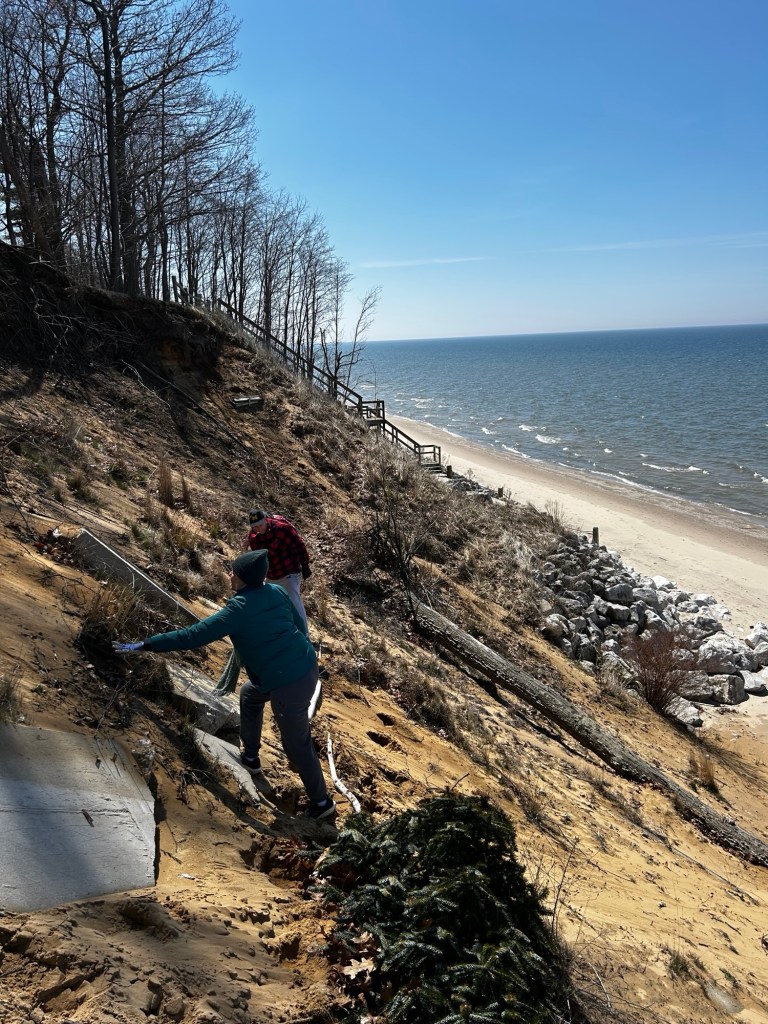
In late April my siblings and I engaged in the annual ritual of opening up the family cottage. Any of you who have a vacation home know that maintaining the property takes a lot of work. Countless decisions must be made and you either spend money hiring someone to take care of your needs. Or you do the chores yourself. We are grateful that there are six of us when confronting a seeming endless list of projects. We cast a unanimous vote to prioritize the task of planting dune grass plugs into our scarred, bare bluff. Nearly five years ago the Lake Michigan water level rose precariously, undercutting our bluff and washing away our stairs. Chunks of our real estate crashed into the waves below. We’ve been waiting for the steep dune to stabilize before putting time and money into it. We decided that this was the year to get on our knees with gardening gloves snapped on.
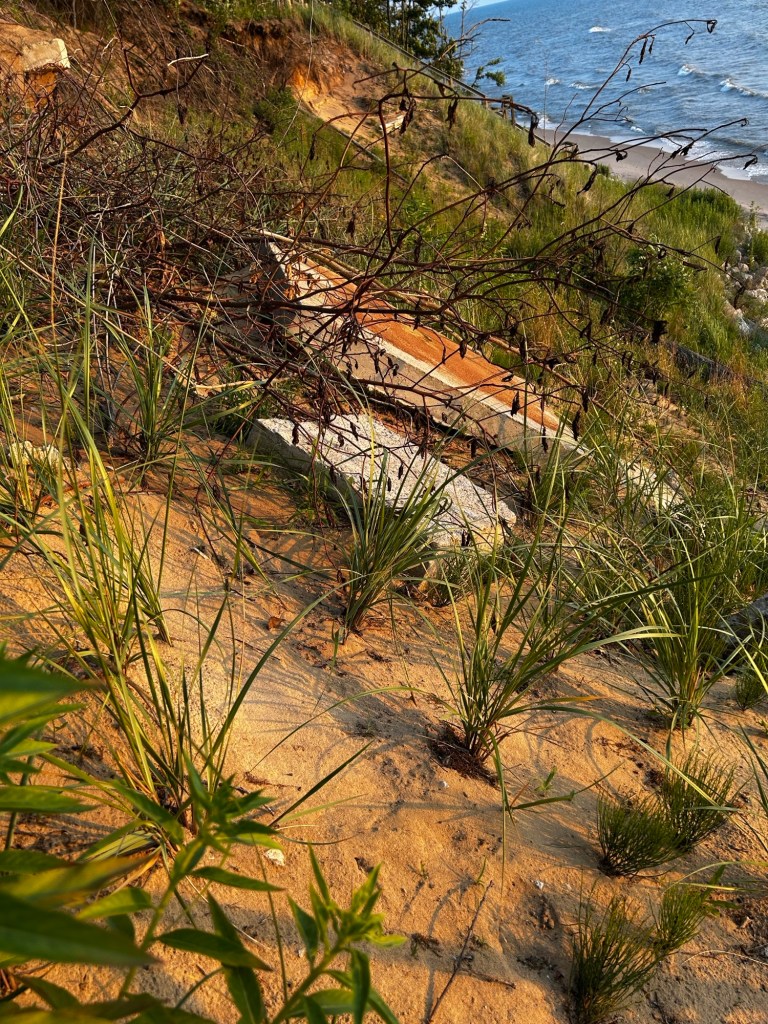
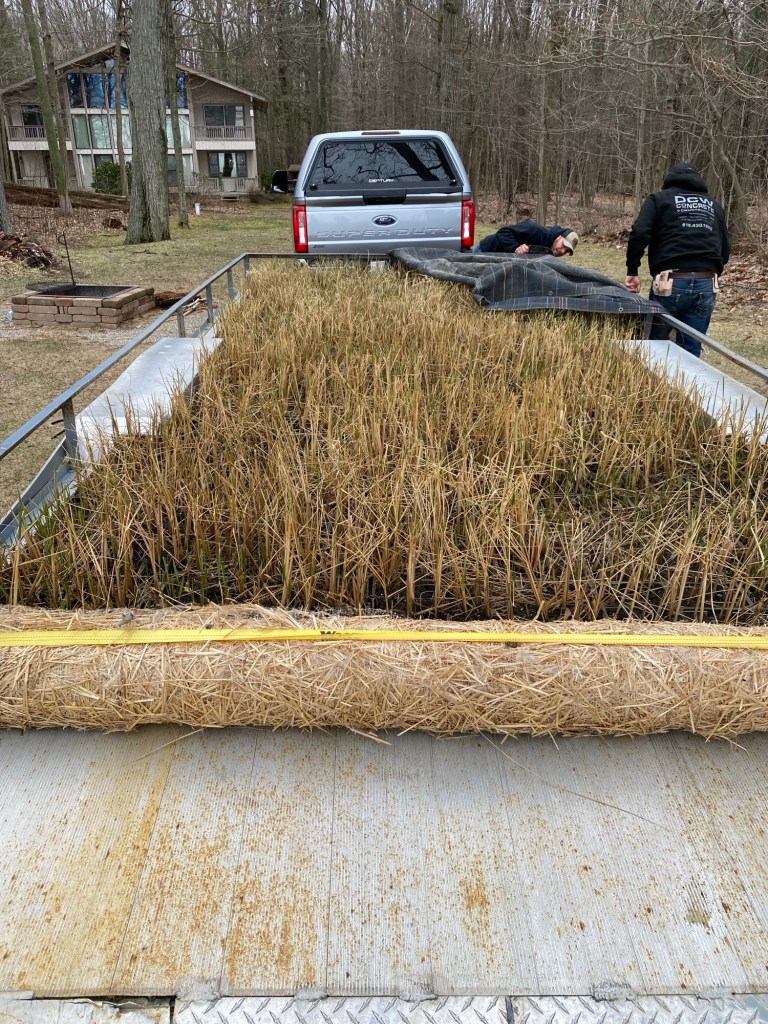
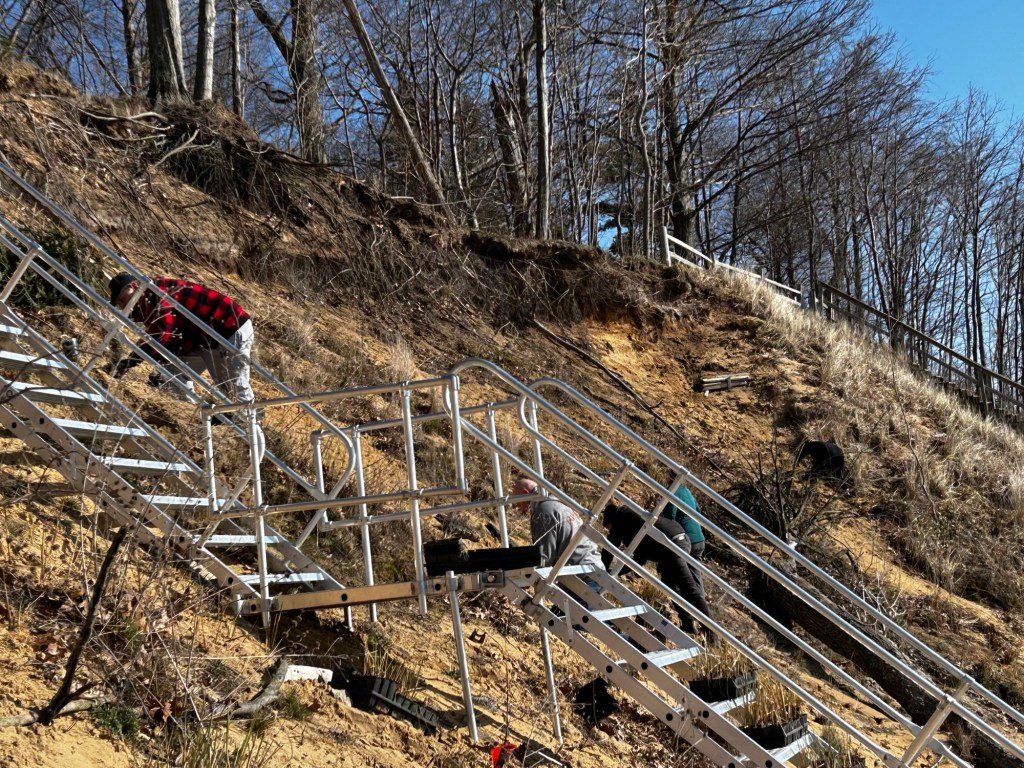
Five of us were able to meet for a long weekend and 4,000 small plugs were delivered. We dedicated a combined 70 hours of labor in 2 ½ days to push fledgling dune grass into cascading sand. At times we were flattened on the incline, Spiderman style, trying to anchor a seedling under the new set of stairs or beneath the fallen trees. It was prayerful exercise: prayers that our work would begin to stabilize this raw drop off and prayers that God would give us the strength needed to complete the job!
This horticultural immersion brought to my mind the scripture from Matthew that names us as fools for having built our house upon the sand. Like many in Michigan and other lakefront get-aways, we build our homes upon sand because it gives us access to refreshing lake properties where generations shape treasured memories. Our great-grandfather purchased the Lakeshore Drive property in the late 1890’s so my grandchildren are the sixth generation to already love this homestead. So, we “elders” willingly squatted, stretched, and dug into sand using muscles that were pushed far beyond their natural limits in an effort to keep our cottage secure.
In the ninth chapter of Acts, we learn of the miraculous activity of the Holy Spirit in establishing the Church. Saul, later renamed Paul, was a well-respected Pharisee raised and educated in the Jewish faith. His practiced intentionality with living out his beliefs resulted in a rock-solid dogma. He preached zealously, even feeling called to persecute new converts to the Christian faith. Paul was repelled by the name Jesus. God wanted to harness Paul’s passion to grow the Church but knew it would take a dramatic spiritual intervention to get his attention. In Acts 20, we read that he was blinded by a light and fell to the ground. Paul heard Jesus asking him why he was persecuting Him. Jesus then directed Paul to finish his journey to Damascus and await further instructions. The rock-solid theology on which he built his life crumbled as he leaned on his companions to take his next steps.
Meanwhile, in Damascus, a devout disciple of Jesus named Ananais was instructed to minister to Paul in spite of the Pharisee’s reputation. Ananais protested but was obedient to God’s leading. He found Paul, still blind and dependent. Ananais laid shaky hands on Paul, the Spirit showed up and scales fell from Paul’s eyes, restoring him to sight. Three days is always a time of dramatic transformation in the scriptures. The way Paul viewed his world was completely changed after his time of spiritual discernment. Jesus’ name became holy for him. Conservative estimates calculate that Paul traveled at least 10,000 miles as an evangelist, planting the Church of Jesus Christ in countless congregations. His life did not become easier because of his commitment—far from it! But throughout the suffering that followed his conversion, he remained faithful to the Truth that Jesus was the crucified and resurrected Son of God.
There is nothing ordinary about following Jesus. Courageously we look for the ways God will use us to plant seeds of faith that reassure our world that resurrection is happening around us!
As I was approaching the church on Easter Sunday, I overheard a conversation between a boy and his father in front of me. The boy, about 7 years old, was wearing a bowtie with a handsome suit. He was yanking at his collar and moaning aloud. The father realized that he needed to do a good sell-job on the Easter outfit so he told his son, “You look so handsome in your suit!” But the boy wasn’t buying it. He groaned more loudly, pulling at his collar, and whined, “You made me too itchy!”
Being a disciple can lead us into uncomfortable situations. Paul’s conversion to faith in Jesus was costly. Preaching Christ resulted in Paul being stoned, beaten, mocked, hunted, and left for dead. He spent the last five years of his life imprisoned because he refused to cease his ministry. However, amidst his suffering, the love of Jesus kept his weary feet planted on solid ground.
Years ago, as a youth pastor, I invited a woman to speak with the youth group one Sunday evening. I hoped her story might awaken in these young minds the miraculous workings of the Holy Spirit. She told the group of teens, clustered on sunken couches and beanbag chairs, that she was raised in a household that taught to her to fear God who might be mad at her for disobeying a blurry list of rules. As an adult she began dating a Christian man. He didn’t pressure her to go to church with him but, on occasion, she did. She listened and found the service and message comforting. After attending services for about six months, one service was different. She told these youth group members that she had a profound epiphany during worship: an assurance that Jesus lived, died on a cross, resurrected from the grave and was, indeed, the Son of God. The eyes of the kids widened as she quietly shared her story. Most of them had been raised in the church and took for granted these points of the Christian doctrine. She wanted them to understand that she had a deep sense of conviction about these new spiritual truths from which she could not be dissuaded. She fielded some questions and then concluded her talk with a request that the kids not talk about her story because she knew it would be upsetting to her family. She was trying to discern the right time to break this news to them and didn’t want word to reach them inadvertently.
When we decide to follow Jesus, we are accepting a new set of trials. But the Holy Spirit accompanies us so we walk through the troubled times gladly.
The passage about preferred foundations for homes is the conclusion to Jesus’ prolonged Sunday School lesson we call the Sermon on the Mount. Jesus urged the crowd to discern between contrasting situations. Remember the speck in your neighbor’s eye versus a beam or log in your own? Or the tree that produces good fruit while another is cursed for yielding nothing at harvest? He discussed laying up treasure on earth instead of looking toward heaven. Anger, lust, divorce, revenge and loving our enemies are weighty themes covered in this extensive catechism. But the comparison between those who build their homes on sand versus rock caps off Jesus’ Sermon on the Mount as presented in both Matthew’s and Luke’s gospels.
When Jesus gives a surprising explanation for what constitutes a “blessed” life, He is leading us to look past the way things appear to be so that we can understand people and circumstances for what they truly are. Jesus pushes us past comfort and into a demanding and ongoing task of planting for a harvest. He sustains us as we push plugs of dune grass into the shifting sands of a steep dune. We stretch and groan, believing that any action done in faith can begin to anchor all of us over time.
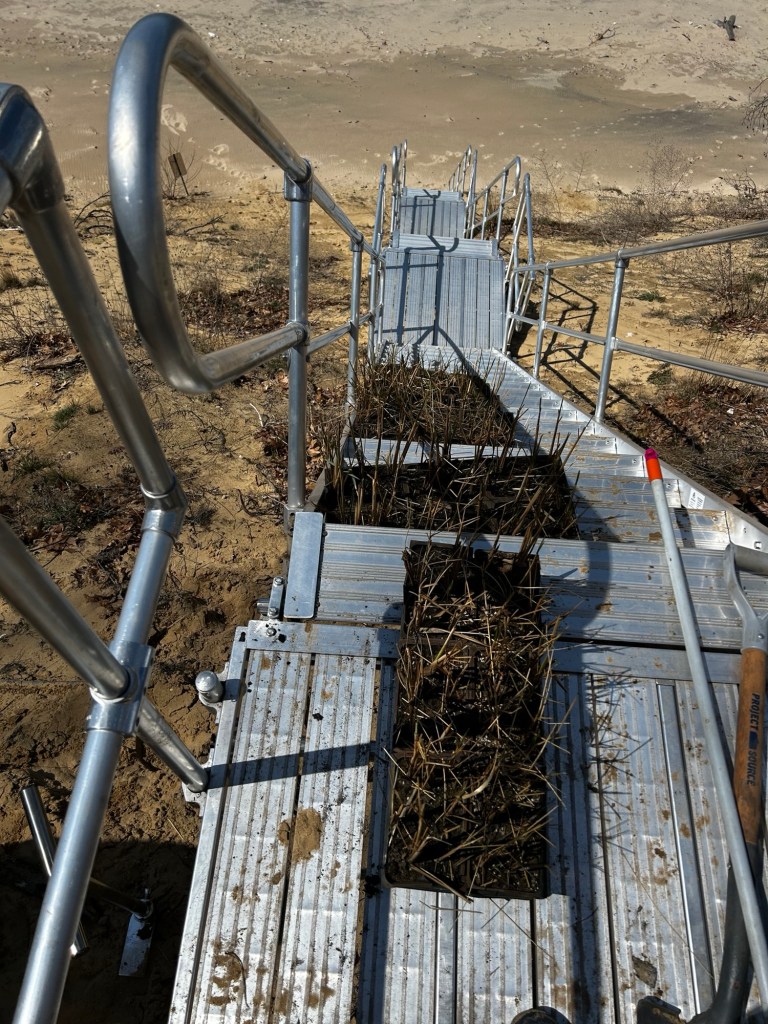
I find it tempting to withdraw from the world when the division is deep and ugly words are thrown about. The political climate of our present time is not hospitable. But we cannot bury our heads in the sand. The waves of our world continue to batter against the shore and undercut the bluff when we’re not watching. For our own survival—and for the sake of those who need us—it is crucial that we be willing to examine not just how to respond lovingly to the present moment. Disciples look beyond the immediate circumstances to understand the long-term implications of each decision. We are called over and over again to follow our faith convictions so that future generations will call us blessed.
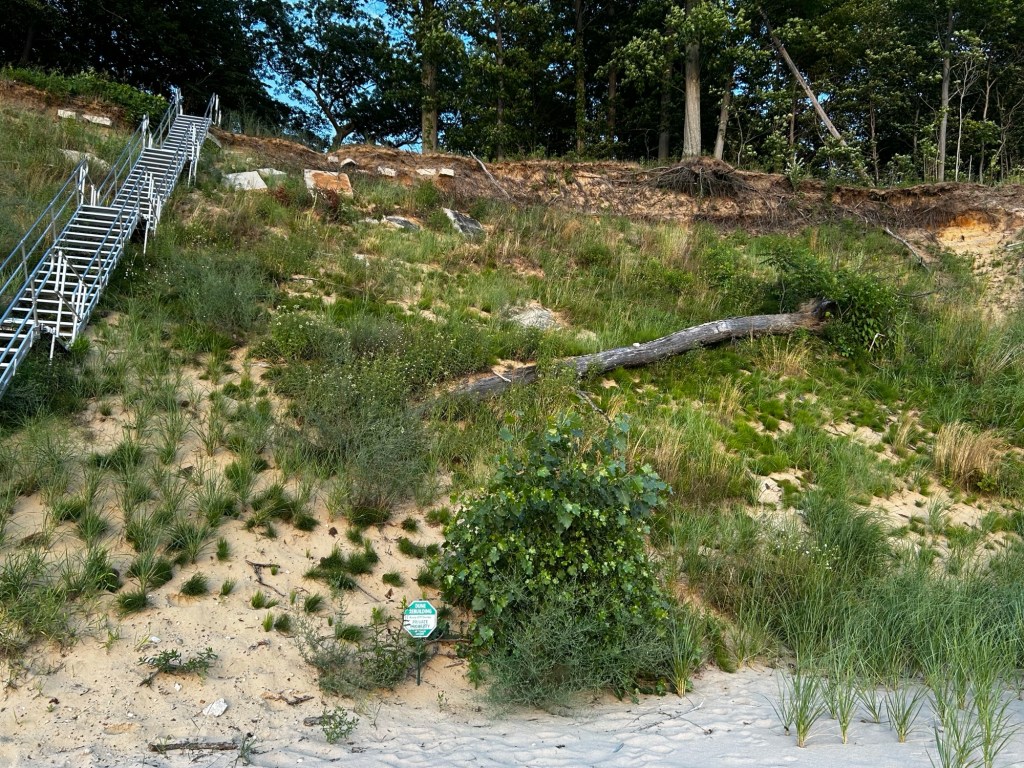
In sharing our faith with others, sometimes our words fail us and the worries that loom in the night cloud our thoughts in the light of day. That’s OK. Committing to follow Christ doesn’t remove our trials. But new life pushes through hard soil, surprising us during desperate times! Jesus shows up like he did to my Youth Group speaker, convicting her beyond a shadow of a doubt that He loved her. Jesus shines a light on something we did or said and the scales fall off, revealing beauty we had overlooked. When we find ourselves living on shifting sands of politics, belief systems, cultural changes or relationship hurdles, we dare to plant carefully-chosen words in our hurting world, believing in their ability to offer stability, to inspire hope, and even massage a truce between enemies.

 Preaching Life